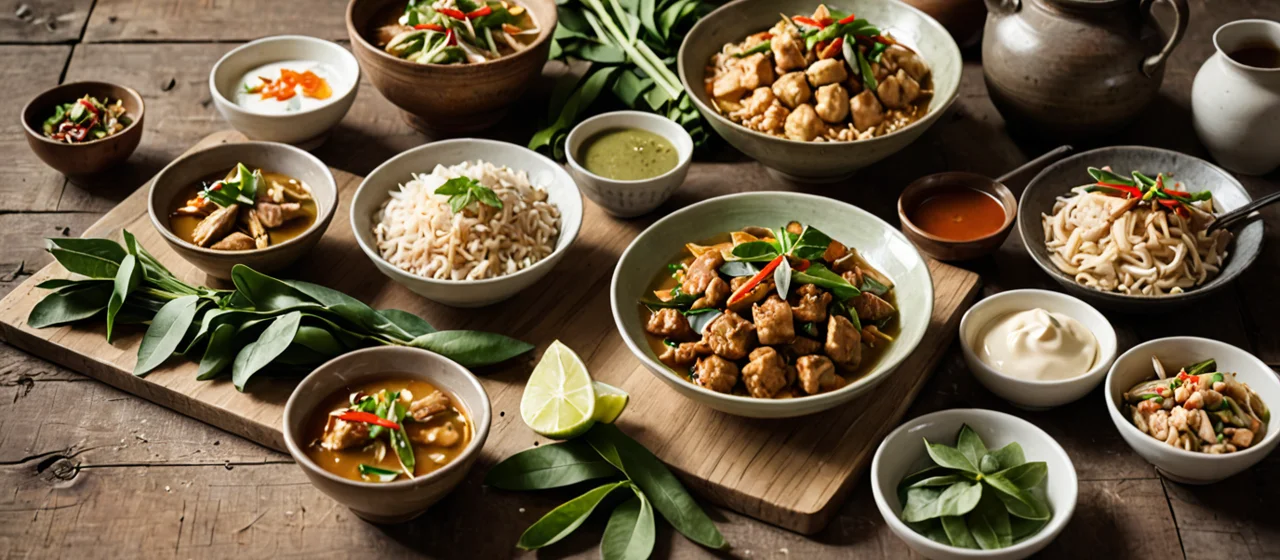
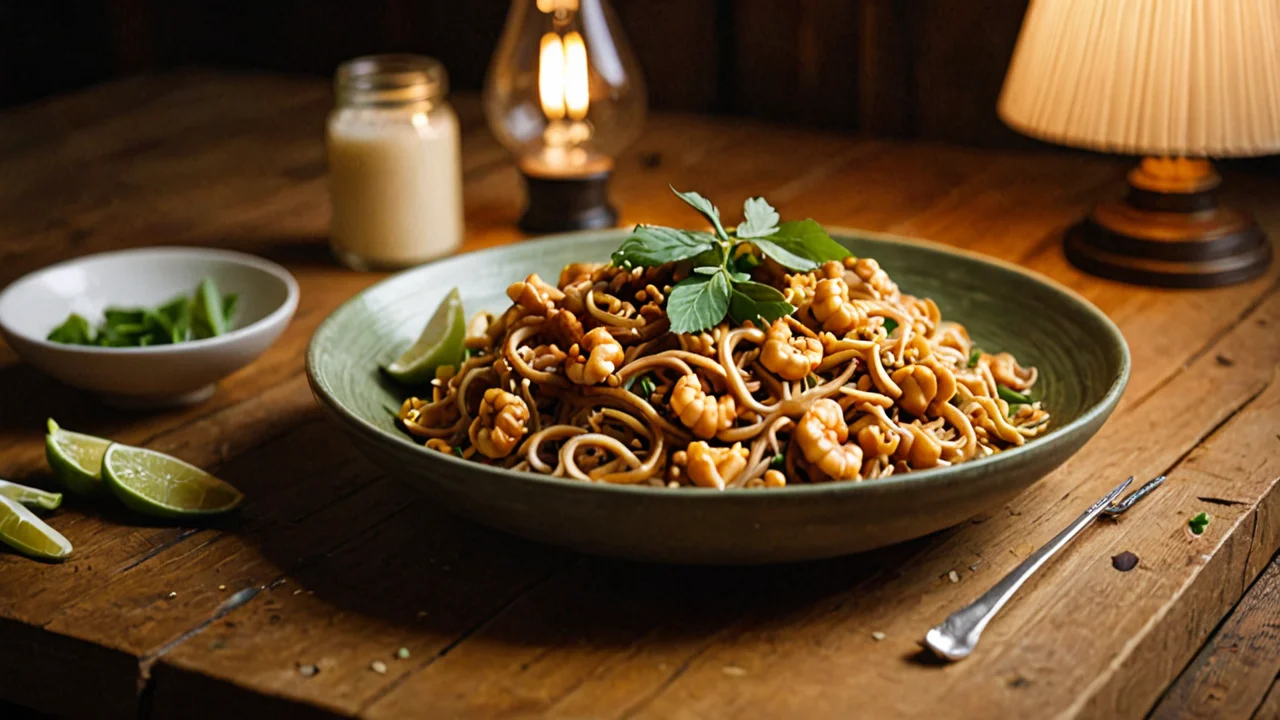
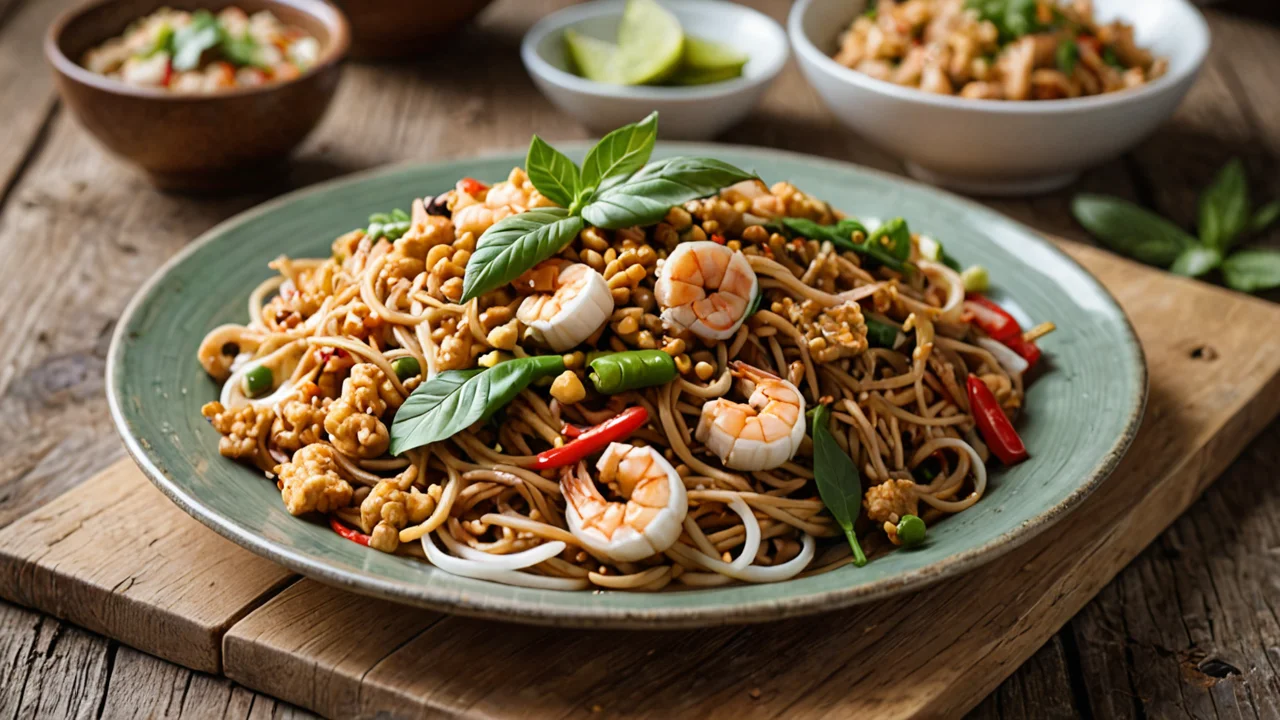
Thai cooking is a balance system, not a recipe list: nearly every dish is built to land somewhere between sour, salty, sweet, and hot, and the cook adjusts those four at the end rather than following a fixed formula. If you understand that frame — plus the handful of ingredients that create it — you can cook Thai food from any market in the United States without hunting for a specialty shop.
The four-flavor balance and how you actually adjust it
Thai dishes are seasoned in layers, and the final adjustment happens off the heat, in the bowl, with four condiments: lime juice, fish sauce, sugar, and chili. Professionals taste constantly and add small amounts, because each one pulls the others around — more lime makes the fish sauce read saltier, more sugar mutes the chili, more chili demands more lime to stay bright. A green curry that tastes flat is almost never undersalted; it is usually missing acid.
What this means in practice is that a Thai recipe's ingredient list is a starting point, not a contract. If your limes are the thin-skinned Persian type common in U.S. supermarkets, they are more acidic and more bitter in the pith than the small Thai limes used in Thailand, so you will use less juice and take care not to press the pith. If your fish sauce is a premium first-press brand, it is saltier and more intense than a bulk brand, so the same tablespoon lands differently. Taste after each addition rather than dumping in the measured amount.
The trade-off is real: balancing at the end means you cannot fully trust a written recipe the first time you cook it, and it means buying four condiments you will use in small amounts. The alternative — following measurements exactly — produces food that is technically correct and consistently a little dull. The condiments keep for a long time, so the cost is upfront and then amortized.
Where the system breaks down is in dishes that are not meant to be balanced at the table. Curries built on curry paste are seasoned in the pot and served as is; noodle dishes like Pad Thai are finished by the cook, not the diner, and the balance is locked in before plating. The four-condiment ritual belongs to soups, salads, stir-fries, and dipping sauces — the food that arrives with a condiment caddy alongside it.
Fish sauce, shrimp paste, and the fermented backbone
Fish sauce is the salt of Thai cooking, and it is not interchangeable with soy sauce. It is fermented anchovy brine — salty, savory, and faintly funky in the way aged cheese is funky — and it provides both the salt and a deep umami base that soy sauce cannot replicate. A stir-fry made with soy sauce instead tastes Chinese, not Thai. Buy a Thai or Vietnamese first-press brand in glass, and accept that the good stuff smells alarming straight from the bottle and turns into something clean and savory the moment it hits hot oil or a lime dressing.
Shrimp paste is the next tier and the one most home cooks skip. It is fermented ground shrimp, dark purple-brown, extremely pungent, and used in small quantities — a teaspoon bloomed in oil or coconut cream before the curry paste goes in. It is what makes a red curry taste like a red curry rather than a spiced coconut soup. If you leave it out, the dish will be pleasant and one-dimensional; there is no substitute that gets you there. Keep a small jar in the refrigerator; it lasts a long time and a little goes far.
The honest cost of this section is that fermented seafood is a hard sell for some households, and there is no workaround that preserves the flavor. Soy sauce, mushroom seasoning, and salt can make a vegetarian version that is good on its own terms, but it is a different dish. If you are cooking for someone who cannot abide fish sauce, build the dish around curry paste, lime, palm sugar, and herbs and stop thinking of it as a substitute — it is its own thing.
Curry paste: buy it, bloom it, and know what it is not
Buy curry paste in a jar or tub rather than making it from scratch, at least until you know the dishes well. A good Thai-brand paste — red, green, massaman, panang, yellow — contains the lemongrass, galangal, kaffir lime peel, shrimp paste, and dried chili that a from-scratch paste requires, and the from-scratch version needs a heavy mortar and a long pounding session that most U.S. kitchens are not set up for. The jarred paste is a legitimate shortcut, not a compromise.
The technique that matters is blooming. Fry the paste in the thick cream that rises to the top of a can of coconut milk — before you add the rest of the liquid — until the oil separates and the paste darkens and smells sweet rather than raw. This takes a few minutes over medium heat and is the difference between a curry that tastes of raw paste and one that tastes finished. Then add the remaining coconut milk, protein, and vegetables, and simmer until cooked through.
Curry paste is also where the heat lives, and it varies wildly by brand. Green is the hottest of the common pastes, red is moderate, massaman and yellow are mild and sweet-leaning. Because you cannot taste the heat until the dish is assembled, add the paste in stages and taste the coconut base after blooming — you can always add more paste, but you cannot take it out. A too-hot curry can be rescued with more coconut milk and a squeeze of lime, but it will be thin.
What jarred paste costs you is nuance. A freshly pounded paste has a brightness and complexity that a jarred one approximates but does not match, and pastes vary in shrimp paste content, so a vegetarian label matters if that is your constraint. Read the ingredient list; some brands are saltier than others, which changes how much fish sauce the finished curry needs.
Rice: the everyday starch and the one that behaves differently
Thai meals are built around jasmine rice — long-grain, floral, and cooked so the grains stay separate. Rinse it until the water runs mostly clear, use roughly one part rice to one and a half parts water by volume, bring to a boil, cover, and cook on low until the water is absorbed, then rest off the heat before fluffing. The rinse matters more than the exact ratio; it removes surface starch that would otherwise make the rice gluey, and it is the step most often skipped.
Sticky rice, eaten in the north and northeast, is a different grain entirely and needs a different method: soaked for hours, then steamed in a basket rather than boiled. It is meant to be clumped and chewed, and it is the correct partner for grilled chicken, larb, and som tam. Do not try to make it by cooking glutinous rice in a pot of water the way you cook jasmine; you will get a dense, uneven mass.
The rice that catches people out is the one they borrow from Japanese cooking. Sushi rice — short-grain Japonica — is seasoned with vinegar, sugar, and salt and cooked to a sticky yet distinct-grain texture. The standard stovetop method is a 1:1.1 rice-to-water ratio, 18 minutes of cooking plus 10 minutes of rest. Calrose, the California-grown medium-grain Japonica widely sold in U.S. supermarkets, is often used as a practical substitute for Japanese short-grain rice, including for sushi-style preparations, and it takes the same 1 part rice to 1.1 parts water.
That last point is worth flagging on a Thai page because it is where home cooks most often go wrong: they assume "rice is rice" and use jasmine for a sticky preparation or Calrose for a stir-fry, and the texture is wrong for the dish even though the rice itself is fine. Match the grain to the job. The trade-off of keeping two or three rices in the pantry is shelf space and the risk of stale rice; buy in quantities you will finish within a few months and store it sealed.
Noodles, and the dishes that define the cuisine abroad
Pad Thai is the dish most U.S. cooks meet first, and it is a stir-fried rice noodle dish originating in Thailand, usually containing rice noodles, eggs, tofu or meat, peanuts, and a tamarind-based sauce. The sauce is the whole game: tamarind for sour, palm sugar for sweet, fish sauce for salt, and chili for heat, cooked down to a syrup before the noodles go in. If you build the sauce in the pan with the noodles, the noodles absorb unevenly and the dish turns gluey.
Soak the dried rice noodles in warm water until pliable but still firm — they finish cooking in the wok, and if you soak them soft they will break apart when stirred. Cook in a hot wok in small batches; overcrowding steams the noodles instead of frying them, and the texture goes pasty. The garnishes are not optional: crushed peanuts, lime, bean sprouts, and chili flakes are what let the eater finish the balance, and without them the dish is one note.
On the health question people actually ask: a 1 cup (200 g) serving of shrimp Pad Thai contains 698 mg sodium, about 30% of the 2,300 mg Daily Value used on U.S. labels. That is a meaningful share of a day's sodium from one serving, and it comes mostly from the fish sauce and tamarind sauce rather than the shrimp. If you are watching sodium, the lever is the sauce — reduce the fish sauce, lean on tamarind and lime for flavor, and go easy on the peanuts if you are also watching calories. The dish is also commonly evaluated for gluten, and the answer depends entirely on the brand of fish sauce and soy sauce used; rice noodles themselves contain no gluten, but cross-contamination and sauces are the risk. Read labels.
Beyond Pad Thai, the noodle dishes worth learning are the ones built on the same logic: pad see ew with wide rice noodles and dark soy, drunken noodles with fresh chili and basil, and boat noodles with a dark, spiced broth. Each has its own sauce logic, and none of them are interchangeable with Pad Thai's. The cost of learning them is buying more than one type of noodle and more than one sauce, which is why most home cooks start with one and expand slowly.
Soups, salads, and the dishes where balance is the point
Thai soups and salads are where the four-flavor system is most visible, because they arrive with the condiments still on the table and the eater finishes them. Tom yum is the archetype: a clear, hot-and-sour broth built on lemongrass, galangal, kaffir lime leaves, lime juice, fish sauce, and chili, with shrimp or mushrooms. The lime juice goes in at the very end, off the heat, or it turns bitter and loses its brightness. The aromatics are not meant to be eaten — they flavor the broth and are pushed aside.
Som tam, green papaya salad, is the other pole: shredded unripe papaya pounded with garlic, chili, lime, fish sauce, palm sugar, tomatoes, and long beans, sometimes with dried shrimp or peanuts. It is pounded, not tossed, so the papaya softens and takes up the dressing. The balance is aggressive — sour, salty, sweet, and hot all at once — and it is meant to be eaten alongside sticky rice and grilled meat rather than on its own.
The soup that raises the most questions in U.S. nutrition guidance is not Thai, but it belongs in the same conversation because people ask about it in the same breath: miso soup, a Japanese soup typically made from dashi and miso paste, often including tofu, seaweed, and green onion, commonly discussed for its sodium content. One cup (245 g) contains 1,144 mg sodium — about half the 2,300 mg Daily Value on U.S. labels. That is a startling number for a light-tasting soup, and it comes from the miso itself. If you are watching sodium, use less miso and more dashi, and treat the bowl as a seasoning rather than a drink.
The honest limit of this whole approach is that Thai cooking rewards repetition more than it rewards equipment. The wok, the mortar, and the steamer basket all help, but the thing that makes the food taste right is cooking the same dish a dozen times and learning how your ingredients behave — how sour your limes are, how salty your fish sauce is, how hot your paste is. That is a slower path than following a recipe once, and it is the only one that gets you to food that tastes like the food you are trying to make.