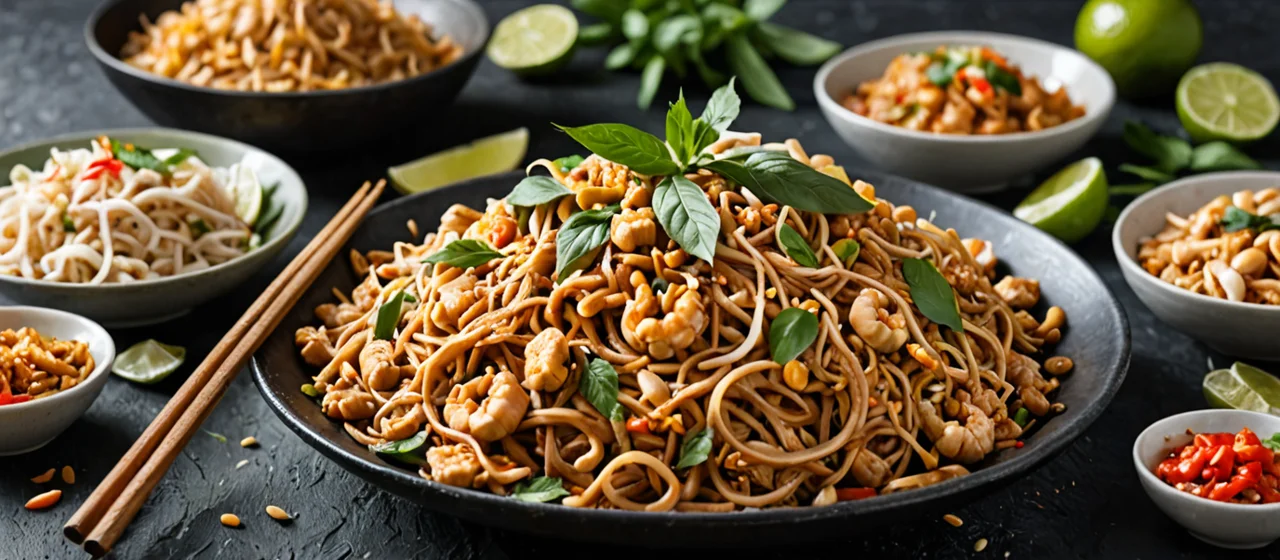
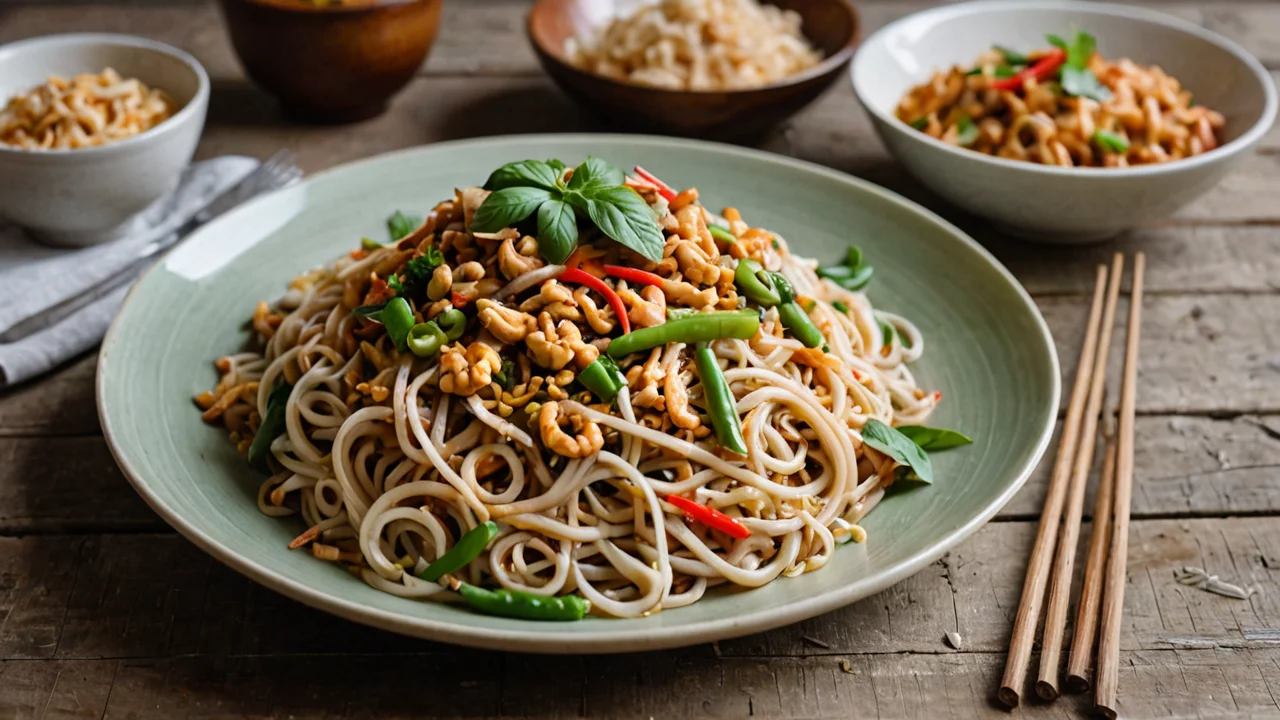
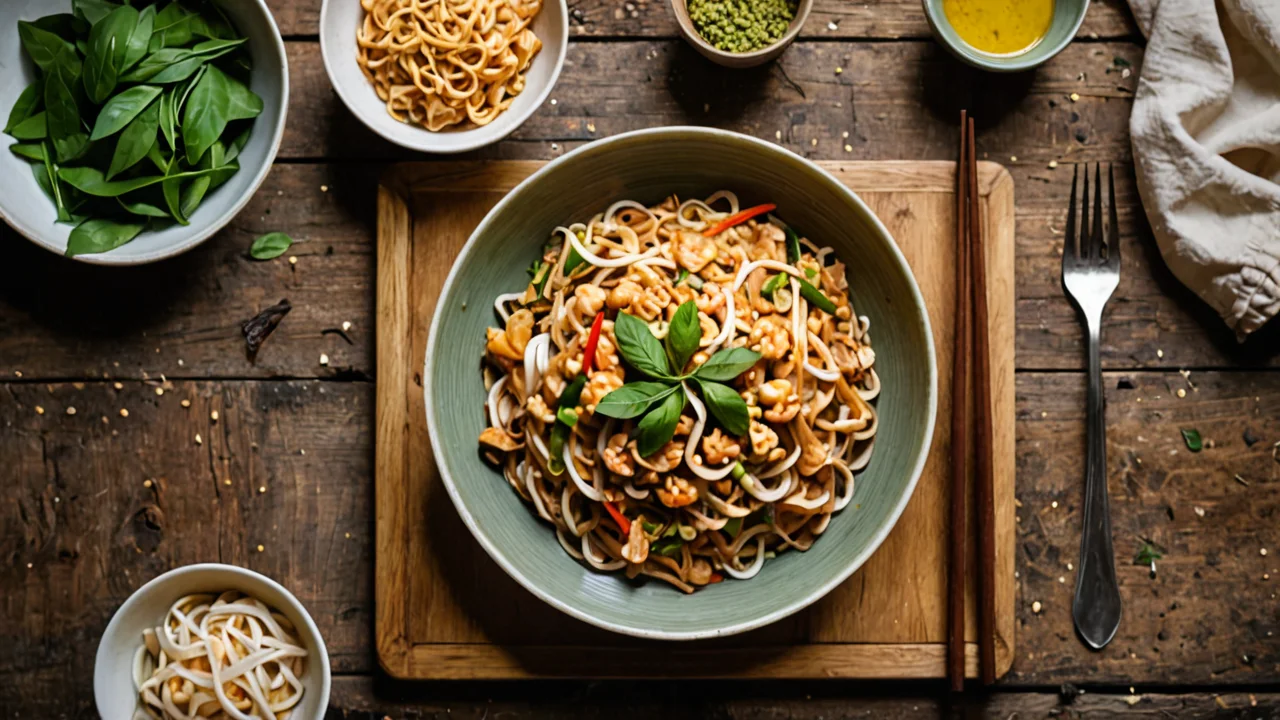
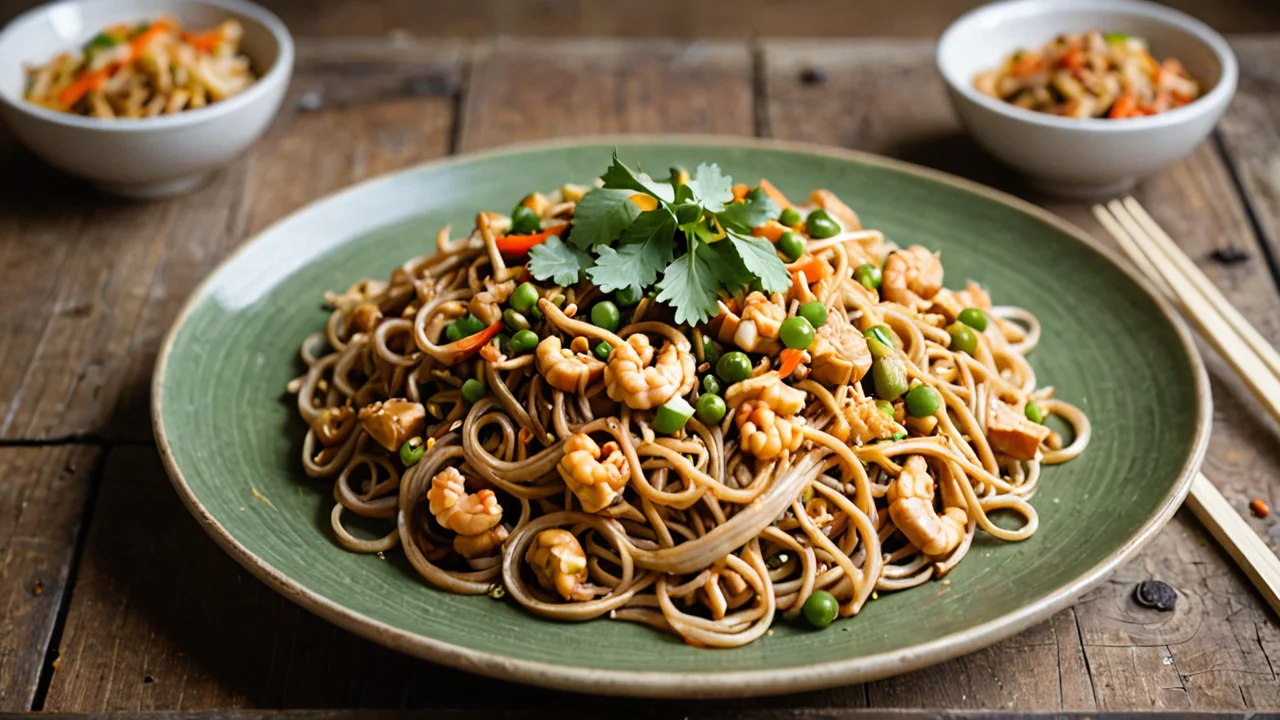
Pad Thai is a stir-fried rice noodle dish built on soaked dried rice noodles, a tamarind-based sauce, egg, and a firm protein, finished with crushed peanuts and raw bean sprouts, and the single decision that determines whether yours tastes like the real thing is how you treat the noodles and the sauce before they ever hit the wok. Everything else — protein, garnish, heat level — is adjustable. Those two are not.
What Pad Thai actually is, and why the wok is the last step
Pad Thai is a stir-fried rice noodle dish originating in Thailand, usually containing rice noodles, eggs, tofu or meat, peanuts, and a tamarind-based sauce. The order of those words matters: the noodles are cooked before they are stir-fried, and the sauce is assembled before it meets the noodles. A wok cannot do either job for you.
Dried rice noodles need to be rehydrated in warm water until they are flexible but still firm at the core — bend one and it should yield without snapping, and it should still taste slightly raw. Pull them early; they finish in the pan. If you soak them to full softness, they will break apart and turn to paste the moment they hit heat, and there is no recovering from that. The failure is obvious in the first thirty seconds of stir-frying: the strands clump and shear instead of separating.
The sauce is tamarind, fish sauce, palm sugar, and often a little lime, and it should be tasted and balanced before cooking. Tamarind paste varies enormously in concentration and acidity between brands, so a fixed recipe ratio is a starting point, not a rule. Taste for sour first, then sweet, then salt. Get that right in a bowl and the wok becomes a timing problem rather than a flavor problem.
What this costs you: two extra vessels and about half an hour of waiting. What it saves you is the entire failure mode. The trade-off is real, though — pre-soaked noodles and a pre-mixed sauce mean you cannot adjust on the fly the way you can with a dish built entirely in the pan. If you prefer cooking by feel and correcting as you go, this is the wrong dish for that instinct. Pad Thai rewards prep and punishes improvisation.
One more structural point: this is a fast stir-fry, which means everything must be within reach before the burner goes on. Protein cooked through, egg beaten, garlic minced, garnishes plated. There is no moment during the cook when you can step away to chop.
Tamarind, fish sauce, palm sugar: the three-way balance and what each one does
Tamarind supplies the sour backbone, fish sauce supplies salt and umami, and palm sugar supplies sweetness and body — and the dish is correct when all three are present without any one of them announcing itself. If you can name the ingredient you are tasting, that ingredient is over-represented.
Tamarind is the one people substitute badly. Tamarind concentrate from a jar is far more intense than tamarind pulp soaked from a block, and swapping one for the other at the same quantity produces a harsh, astringent sauce. Start with less concentrate than the pulp equivalent and build up. If you cannot find tamarind at all, lime juice plus a little brown sugar gets you in the neighborhood, but it is a different dish — brighter and thinner, missing the fruity depth that makes Pad Thai recognizable.
Fish sauce is not interchangeable with soy sauce. Soy gives you salt without the fermented seafood funk that is central to the flavor. If you are cooking vegetarian, a mushroom-based seasoning sauce is the closest analogue, and it will taste like a different but coherent dish rather than a compromised one.
Palm sugar comes in hard discs and needs to be shaved or grated before it will dissolve. Brown sugar works as a substitute and dissolves more easily, at the cost of a slightly molasses-heavy finish. Either way, dissolve the sugar into the liquid components over low heat before you taste, or you will be adjusting against undissolved grit.
The honest limit here: balance is a matter of palate, and Thai home cooking varies by region and household. There is a recognizable target — sour-forward, sweet-supported, salty-finished — but not a single correct ratio. Taste, adjust, and stop when nothing sticks out.
Protein, tofu, and the egg: sequencing a stir-fry that will not steam
Cook the protein first and remove it, scramble the egg separately, and only then combine everything with the noodles — because a wok loaded with wet ingredients drops in temperature and steams instead of searing. That is the whole principle, and it applies regardless of what protein you choose.
Shrimp is the most common and the least forgiving. It releases water as it cooks, so it goes in a hot dry-ish wok for a short time and comes out before it curls tight. Firm tofu should be pressed to remove excess water and pan-fried until it has a crust before it joins anything; unpressed tofu will crumble and water down the sauce. Chicken or pork should be sliced thin and cooked through first, since it will not have time to finish later.
The egg is where home cooks lose texture. Push the aromatics to one side, pour the beaten egg into the cleared space, let it set for a few seconds, then break it up and fold. Egg mixed into the noodles too early coats every strand and makes the dish gluey.
Garlic and shallot go in after the protein comes out, in the residual fat, just until fragrant. Burnt garlic is bitter and there is no removing it from the dish.
The cost of this sequencing is more steps and more dirty plates — cooked protein resting on a plate, egg on another. The benefit is that each component hits the wok at the right moisture level. If you are cooking for a crowd and want one-pan simplicity, this is not the dish to reach for; a braised noodle dish will feed people with far less attention.
Noodles, heat, and the moment the dish comes together
Get the wok properly hot before the noodles go in, add them in a quantity the pan can actually hold, and toss constantly — because overcrowding is the most common reason home Pad Thai turns out soft and pale instead of seared and separate. A wok that is too full cannot recover its heat, and the noodles sit in their own moisture.
Cook in batches if you must. Two smaller, properly seared portions will beat one large, steamed one every time, and the second batch takes only minutes once the pan is hot again.
Once the noodles, sauce, and protein are combined, the dish is nearly done — the sauce should coat and absorb rather than pool. If there is liquid in the bottom of the wok, the heat was too low or the noodles were too wet going in. Turn the heat up and keep tossing, but know that you are now correcting rather than cooking.
Timing cues matter more than clock time here. The noodles are done when they are tender but still distinct, the sauce clings rather than runs, and the edges of some strands have picked up color. That is the window — a minute or two either side and you are into mushy or stiff territory.
The trade-off with high heat is smoke and splatter. A carbon steel wok handles it; a nonstick pan does not like it and will eventually degrade. If nonstick is what you have, keep the heat moderate and accept a softer, less charred result rather than destroying the pan.
Garnishes, and the sodium and gluten questions people actually ask
Crushed roasted peanuts, raw bean sprouts, lime wedges, and often dried chili flakes go on at the table, not in the wok — they supply crunch, freshness, and acidity that cooking would destroy. Bean sprouts stirred in at the end stay crisp; bean sprouts cooked from the start go limp and watery.
On sodium: a 1 cup (200 g) serving of shrimp Pad Thai contains 698 mg sodium, which is 30% of the 2,300 mg Daily Value used on U.S. labels. That is a substantial share of a day's sodium in a single cup, and it comes mostly from the fish sauce and the tamarind-based sauce rather than from the noodles. For comparison, 1 cup (245 g) of miso soup carries 1,144 mg sodium — roughly half the same Daily Value. Pad Thai is the lighter of the two, but neither is a low-sodium dish, and if you are watching intake, the sauce is the lever: reduce the fish sauce, taste, and add acid rather than more salt to keep the flavor from going flat.
On gluten: Pad Thai is frequently evaluated for gluten content precisely because the name suggests nothing about wheat, and the answer depends almost entirely on the fish sauce and soy-adjacent seasonings you use. Rice noodles themselves contain no wheat. Check the fish sauce label — some brands include wheat-derived ingredients — and if you substitute soy sauce for fish sauce, use a certified gluten-free one.
Peanuts are the other common question, and the answer is simply to omit them and increase the lime and chili at the table; the dish loses crunch but holds together.
Where Pad Thai sits next to the rice dishes it gets confused with
Pad Thai is a rice noodle dish, not a rice dish, and none of the techniques for cooking rice apply to it — but the confusion is common enough to be worth separating, because the two get lumped together in the same aisle and the same search results. Pad Thai's noodles are dried, soaked, and stir-fried. Rice is boiled or steamed, then seasoned.
If you are cooking sushi-style rice alongside or instead, the numbers are specific and worth keeping straight. Sushi (short-grain Japonica) rice is cooked at a ratio of 1:1.1 rice to water, for 18 minutes plus 10 minutes rest. Calrose, a medium-grain Japonica variety developed in California that becomes slightly sticky when cooked, is often used as a practical substitute for Japanese short-grain rice in U.S. kitchens, and its cooking ratio is also 1 part rice to 1.1 parts water. Sushi rice is then seasoned with vinegar, sugar, and salt to a sticky yet distinct-grain texture.
| Dish | Base | Method | Ratio / timing |
|---|---|---|---|
| Pad Thai | Dried rice noodles | Soak, then stir-fry | Soak until flexible but firm; no fixed ratio |
| Sushi rice | Short-grain Japonica | Cook, rest, season with vinegar | 1:1.1 rice to water; 18 min cook, 10 min rest |
| Calrose rice | Medium-grain Japonica | Cook as sushi-style rice | 1 part rice to 1.1 parts water |
The practical overlap is that both dishes depend on a starch that is cooked to a precise texture before it is finished — and both punish overcooking in ways you cannot undo. The difference is that rice is corrected with seasoning after the fact, while Pad Thai is corrected with sauce before.
Where this comparison stops being useful: the ratios above are for rice, and applying a "ratio" mindset to Pad Thai noodles will lead you astray. Noodle soaking depends on the thickness of the noodle, the temperature of the water, and how long the package has sat in your cupboard. Feel the noodle, not the clock.
Fish sauce brands are not interchangeable, and the label is where you find out why
Buy fish sauce by reading the ingredient line, not the price: a bottle whose first ingredient is anchovy and salt, with nothing else, behaves differently from one stretched with sugar and water, and the difference shows up as a sauce that tastes salty-sweet rather than savory. The 698 mg sodium in a 1 cup (200 g) serving of shrimp Pad Thai comes mostly from the fish sauce and the tamarind-based sauce, so the brand you pick moves that number before you have tasted anything.
Two practical consequences. First, taste a new brand before you commit a whole batch of sauce to it — a small spoonful tells you how much salt it carries relative to the fish flavor. Second, once you have adjusted the sauce for a given bottle, write down what you did. Replacing that bottle with another brand means rebalancing from scratch, because the salt-to-umami ratio is not standardized. The trade-off is that a cheap, mild fish sauce can actually be forgiving for beginners — it is harder to overshoot — while a strong, well-made one rewards precision and punishes a heavy hand.
Wok hei is a restaurant result, and your stove is the reason
Home burners will not produce the smoky char that defines wok-fried Pad Thai in Thailand, and no technique closes the gap entirely — commercial burners put out far more heat than a domestic range, and the wok sits closer to a flame that is not there. What you can do is remove the two things that prevent the heat you do have from working: wet noodles and a crowded pan.
Dry the soaked noodles as much as you can before they go in, and cook in portions small enough that the wok stays hot. The noodles should pick up color at the edges, not steam pale. If you are chasing char at the cost of texture, you have the priority wrong — the texture is the part you can control, and a properly seared, separate-strand result on a home stove is a better dish than a scorched one.